

Objective
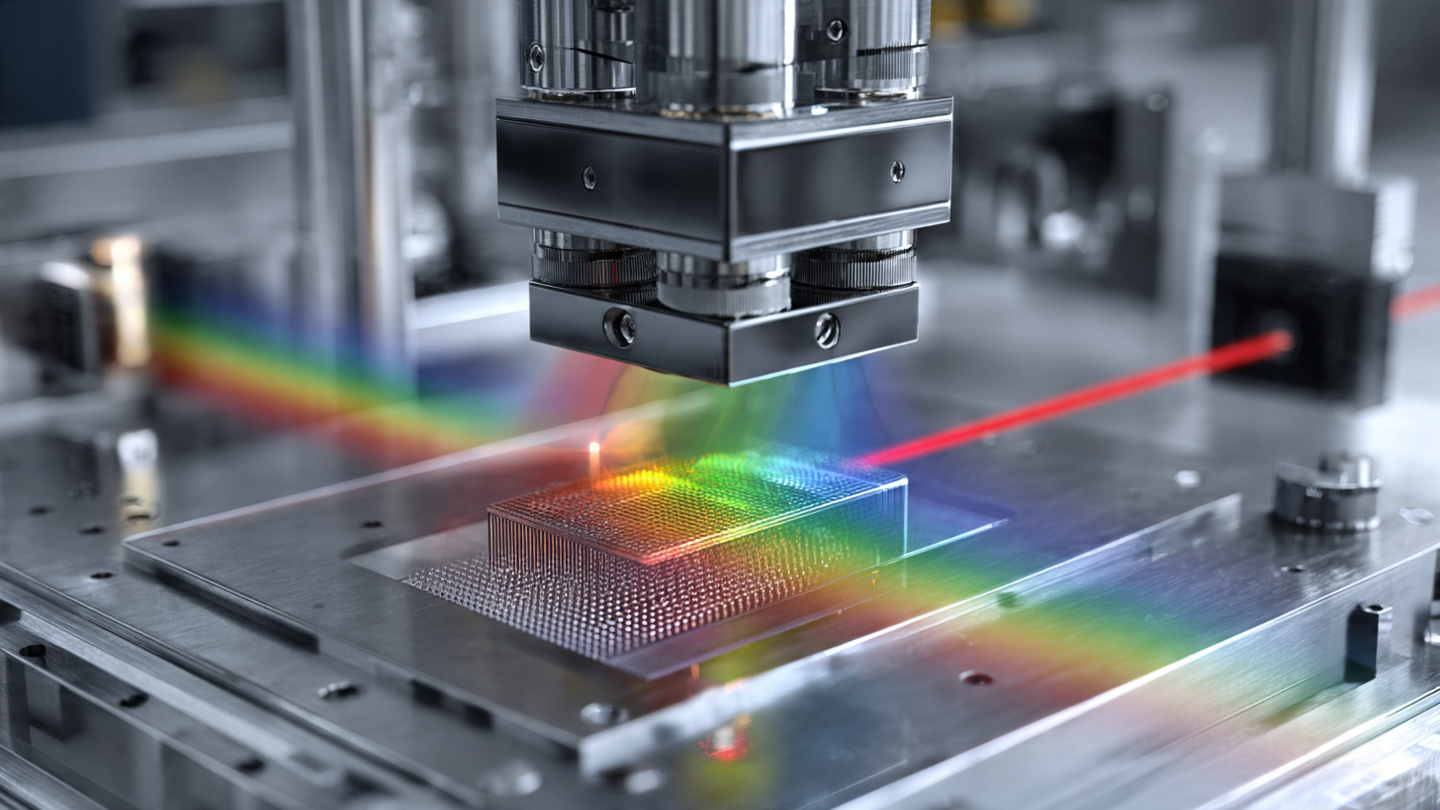
We want to achieve a real time 3D full color holographic display. We intend to use a metasurface to record the CGH (Computer Generated Hologram)/Diffraction pattern and use the metasurface in an optical setup to reconstruct the hologram at a certain distance. We are looking to work with visible wavelengths which will help us in achieving full color holography.
Device setup
Explanation
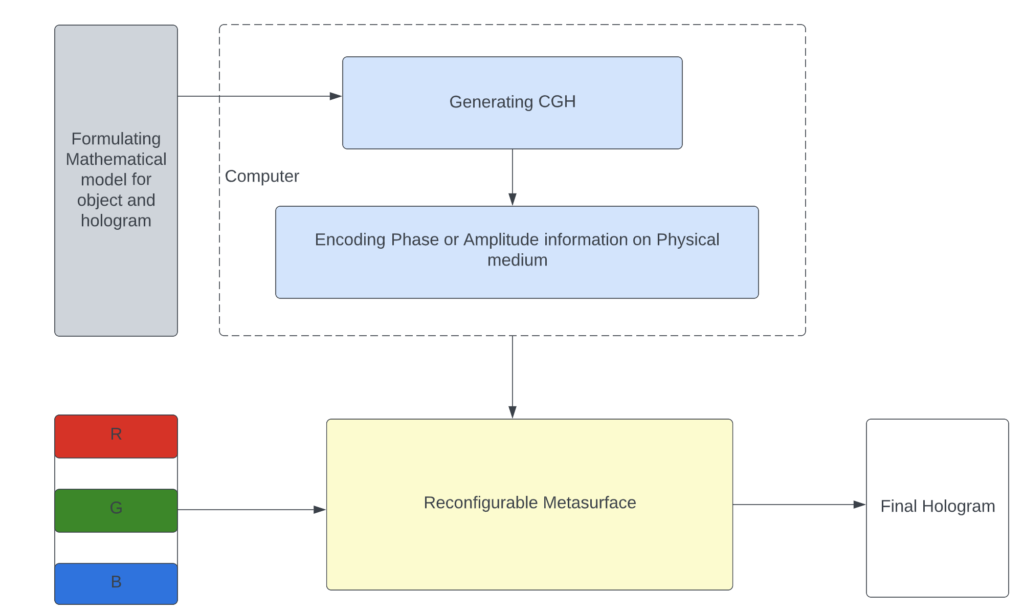
First we will calculate the CGH pattern of a 3D object. Once we get the diffraction pattern, we will be encoding the phase information onto a reconfigurable metasurface via voltage bias or UV laser pulses (depending on the type of metasurface we choose). Then by passing RGB laser onto the metasurface we will be generating full color holography onto a holographic plane at some distance. The whole process of generating CGH and recording it onto the metasurface will be real-time.
Expected holographic output to have below configuration
-
Frame rate: 60fps. This is the speed at which the dynamic video will run at. For smoother experience, a minimum of 60fps is required.
-
Refresh rate: 60hz. This is the frequency at which the screen resets to its initial phase to take in new information. For real-time applicability, a minimum of 60Hz is required.
-
Field of view: 120º. This determines the viewing angle of the display. 120º will make it possible for multiple viewers to view the 3D content.
-
Input Wavelength: Visible range (380 nm to 700 nm). Since we want to achieve full color holography we will be looking to be working with white light or in the visible range (380 nm to 700 nm).
-
2×2 inch module: we will need 2×2 inch metasurface module to have 3840 x 2610px resolution
-
Metasurface the we are expecting should not have high temperature transition to achieve desired phase
-
Holograms should be visible to a certain distance D from the metasurface. Distance D should be `run time controllable to some extent.
Metasurface Overview
We were exploring conventional methods while figuring out the approach which we’ll take to reconstruct the holograms. The conventional methods used Spatial Light Modulators (SLMs) to modulate either the phase or amplitude of light. To produce good quality holograms, SLMs require an extremely large number of pixels with a small pixel pitch, however, pixel sizes of current SLMs are of the order of micrometers, which leads to a few disadvantages:
-
Low resolution
-
Low signal to noise ratio
-
Small viewing angles
-
Undesired high order diffraction
-
Twin image issues
-
Cost
We felt these issues might hinder the future development of our project and might make it difficult to scale our project. Therefore, to maximize the advantages of holographic display, light modulating pixels need to be spaced near to or below the wavelength of light. Flat surface optics which used Metamaterials/Metasurfaces to achieve light modulation looked like a feasible solution to us as the thickness of the surface is of nanometer scale and possesses the capability to solve all the issues current generation SLMs face.
We understood the working of Metasurface in the field of Holography[1]. Metasurface can be used to reconstruct holograms in both the reflective as well as transmissive mode based on the material used for the fabrication and also based on the various principles of physics we use.
Our end goal is to achieve full color holography in real-time, we started exploring the various types of metasurface which would make it possible for us to achieve this particular goal. For real-time applicability it is important for the metasurface to be active, i.e., The metasurface must be reprogrammable. This opens up the field of dynamic meta holography[2]. Based on our requirements we came across a few materials and designs we could use to create a dynamic/reconfigurable metasurface and they are as follows:
Phase Change Materials (PCMs)
Phase Change Materials or PCMs are currently the most widely used component to realize dynamic holography from a metasurface. These materials undergo a phase change from amorphous to crystalline state upon reaching a certain transition temperature and have extremely different refractive indices in their two different states. The change in temperature can be brought by two means:
-
Optical switching: Laser pulses are used to bring about the change in temperature and accordingly the state of the material changes from amorphous to crystalline.
-
Electrical switching: A voltage bias is used to increase the temperature of sub-units which undergo a change in state upon reaching the transition temperature.
We found about a few such materials which we could use as dynamic metasurfaces:
-
GST: It is an alloy of Germanium, Antimony and Tellurium (GST) and is one such material currently being used to realize dynamic metasurfaces for holography. GST undergoes a change from amorphous to crystalline state at 160ºC, and this change happens in the order of 300ns[3].
-
GSST: The GST compound can be combined with Selenium which forms the GSST compound. Compared to the prevailing GST alloys, GSST offers three unique advantages specific to active metasurfaces:
-
Its broadband transparency across different structural states mitigates optical losses.
-
Its much larger switching volume allows for optically thick PCM structures to boost light-PCM interactions while maintaining dynamic and fully reversible switching capacity[4].
-
The transition temperature is around 68ºC which is comparatively very less than that of GST and makes it easier to handle.
-
-
Vanadium Dioxide (VO2): Another material which shows change in its optical properties upon change in temperature. Unlike GST or GSST it undergoes change from an Insulator state to Metallic state. This switching happens at about 67ºC. This temperature can also be brought down to room temperature by doping VO2 with Tungsten. The IMT brings on changes of the optical properties that are reversible with a long lifetime, as long as the VO2 can be protected from oxygenation to prevent the formation of V2O5. We are not actively looking at VO2 as a solution as its volatile nature can prove to be disturbing to our system[3][5].
PMMA
Another solution to reprogrammable metasurface was using a layer of PMMA over gold nanorods[6]. Four gold nanorods are arranged in a specific geometric phase profile and a layer of PMMA is deposited on top of it. The phase of light can be altered by creating openings in the PMMA layer by Electron Beam Lithography (EBL). To erase the phase information on the PMMA layer it can be dissolved in acetone which restores its initial phase and subsequently a new PMMA layer can be patterned to produce different phase delays.
Gold Spiral-like Meta-atoms
An electromechanical configuration can be deployed to reprogram metasurfaces. This structure uses gold spiral-like meta-atoms which undergo a change in its length upon the application of voltage. This change in length produces change in phase delays which is used to reconstruct the hologram[7]. Upon mapping voltage to phase change we get to know that a range of 0 to10.5V is used to create a phase change of 0 to 1.95π.
Role of Machine Learning in Active Metasurfaces
The various methods explored to encode the phase pattern onto the metasurface can become a time consuming task since we require control over each pixel. We can formulate a look-up table which relates the different voltages to the different phase angle, but since we are looking to generate infinite content, the data in the look-up table might exhaust at some point. To ease this process we are planning to deploy Machine Learning Algorithms to make the process of encoding fast. A mathematical model based on the input voltage and output phase information can make the calculations faster which will help us in realizing the 60fps frame rate and 60Hz refresh rate.
As mentioned above, our end goal is to achieve full color holography in real-time. For full color holograms through a metasurface we explored various procedures available. Full color holography means we need to be using white light or we must be able to combine the red (R), green (G) and blue (B) channels of light in an efficient way. Two procedures we think might be beneficial to achieve this are:
A 3D Integrated Color Filter
A metasurface module consisting of a hologram metasurface on a monolithic Fabry–Pérot cavity-based color filter microarray is used to simultaneously achieve low-crosstalk, polarization-independent, high-efficiency, full-color holography, and microprint[8]. In the demonstration a color microprint image is observed when the device is illuminated by white light, while a full-color hologram image can be projected into the far field under red (R), green (G), and blue (B) laser illumination by mixing three independent greyscale hologram images. Compared to the existing approaches for full-color holography, which have been demonstrated with plasmonic nanostructures and dielectric nanostructures, the current device based on 3D-integrated metasurfaces has the advantages of low crosstalk, polarization independence, high efficiency, and simple fabrication process.
Rewritable Color-Selective Diffractions
Most of the methods currently being researched for full color holography are for displaying static objects or dynamic pre-recorded holographic videos. We intend to create a display which will do this task in real-time. For this we came across Rewritable full-color computer-generated holograms based on color-selective diffractive optical components including phase change materials[9]. The structure for this, includes an ultrathin layer of phase-change material GST on which a spatial binary pattern of amorphous and crystalline states can be recorded. The CGH patterns can be easily erased and rewritten by the pulsed ultraviolet laser writing technique owing to the thermally reconfigurable characteristic of GST.
References
[1] Qiang Jiang, Guofan Jin, and Liangcai Cao, “When Metasurface meets Holography: Principles and Advances”, https://doi.org/10.1364/AOP.11.000518
[2] Hui Gao, Xuhao Fan, Wei Xiong and Minghui Hong, “Recent advances in optical dynamic metaholography”, https://doi.org/10.29026/oea.2021.210030
[3] Trevon Badloe, Jihae Lee, Junhwa Seong, and Junsuk Rho, “Tunable Metasurfaces: The Path to Fully Active Nanophotonics”, https://onlinelibrary.wiley.com/doi/pdf/10.1002/adpr.202000205
[4] Yifei Zhang , Clayton Fowler and Junhao Liang, “Electrically reconfigurable non-volatile metasurface using low-loss optical phase-change material”, https://doi.org/10.1038/s41565-021-00881-9
[5] Liu, X., Wang, Q., Zhang, X., Li, H., Xu, Q., Xu, Y., Chen, X., Li, S., Liu, M., Tian, Z., Zhang, C., Zou, C., Han, J., Zhang, W., “Thermally Dependent Dynamic Meta-Holography Using a Vanadium Dioxide Integrated Metasurface”, https://doi.org/10.1002/adom.adom201900175
[6] Jianxiong Li, Ping Yu, Shuang Zhang and Na Liu, “A Reusable Metasurface Template”, https://doi.org/10.1021/acs.nanolett.0c02876
[7] Yu Han, Shanshan Chen, Changyin Ji, Xing Liu, Yongtian Wang, Juan Liu, and Jiafang Li, “Reprogrammable optical metasurfaces by electromechanical reconfiguration”, https://doi.org/10.1364/OE.434321
[8] Hu, Y., Luo, X., Chen, Y., “3D-Integrated metasurfaces for full-color holography”, https://doi.org/10.1038/s41377-019-0198-y
[9] C. Y. Hwang, G. H. Kim, J. H. Yang, C. S. Hwang, S. M. Cho, W. J. Lee, J. E. Pi, J. H. Choi, K. Choi, H. O. Kim, S. Y. Lee and Y. H. Kim., “Rewritable full-color computer-generated holograms based on color-selective diffractive optical components including phase change materials”, https://doi.org/10.1039/C8NR04471F