



As software systems evolve toward autonomy and intelligence, traditional architectural patterns are struggling to provide sufficient structure, governance, and long-term adaptability. While microservices and event-driven architectures address infrastructure scalability, they often fail to scale domain complexity and decision ownership.
This article presents an architectural approach that integrates Agent-to-Agent (A2A) communication and the Model Context Protocol (MCP) with Domain-Driven Design (DDD). Together, these concepts enable systems that are modular, intelligible, governable, and aligned with real-world business domains.
The focus is not on AI as a feature, but on intelligence as a first-class architectural concern.
The Structural Limitations of Conventional Architectures
Modern distributed systems frequently exhibit the characteristics of a “Distributed Monolith”:
- Weak Domain Ownership: Clear technical service boundaries (containers, repos) but tangled business logic.
- Implicit Rules: Business rules are spread across multiple services, requiring synchronous coordination for simple changes.
- Orchestration Complexity: Centralized orchestration layers that accumulate “spaghetti code.”
- Opaque Decision Making: Limited visibility into why a specific automated decision was made.
While DDD provides a conceptual framework for modeling business domains, most implementations stop at design-time constructs. Runtime collaboration, decision enforcement, and domain governance are typically left to ad-hoc integrations. As systems adopt intelligent components, this gap becomes an existential risk.
Domain-Driven Design as the Semantic Backbone
Domain-Driven Design establishes the semantic foundation of the system through:
- Bounded Contexts that define authoritative domain boundaries.
- Ubiquitous Language that aligns business and technical stakeholders.
- Aggregates and Domain Services that encapsulate invariants and behavior.
- Domain Events that represent meaningful state changes.
However, DDD does not prescribe how autonomous components should coordinate across contexts, nor how intelligent decision-making should be constrained at runtime. This is where A2A and MCP extend the model.
Agent-to-Agent Communication as a Domain Collaboration Model
From Services to Domain Agents
A domain agent is an autonomous runtime component that:
- Owns a bounded context.
- Encapsulates domain logic and decision authority.
- Communicates intent rather than implementation details.
- Evolves independently of other domains.
The Conceptual Shift: Execution vs. Evaluation
Agents differ from traditional services by shifting the contract from execution (do strictly this) to evaluation (solve this based on your domain knowledge).
Instead of:
“Call Service B to compute value X using formula Y”
The interaction becomes:
“Request a domain evaluation from the Pricing Agent regarding Context Z”
This distinction is critical in complex systems where the “how” often changes dynamically based on data.
Diagram: Domain Agents and Bounded Contexts
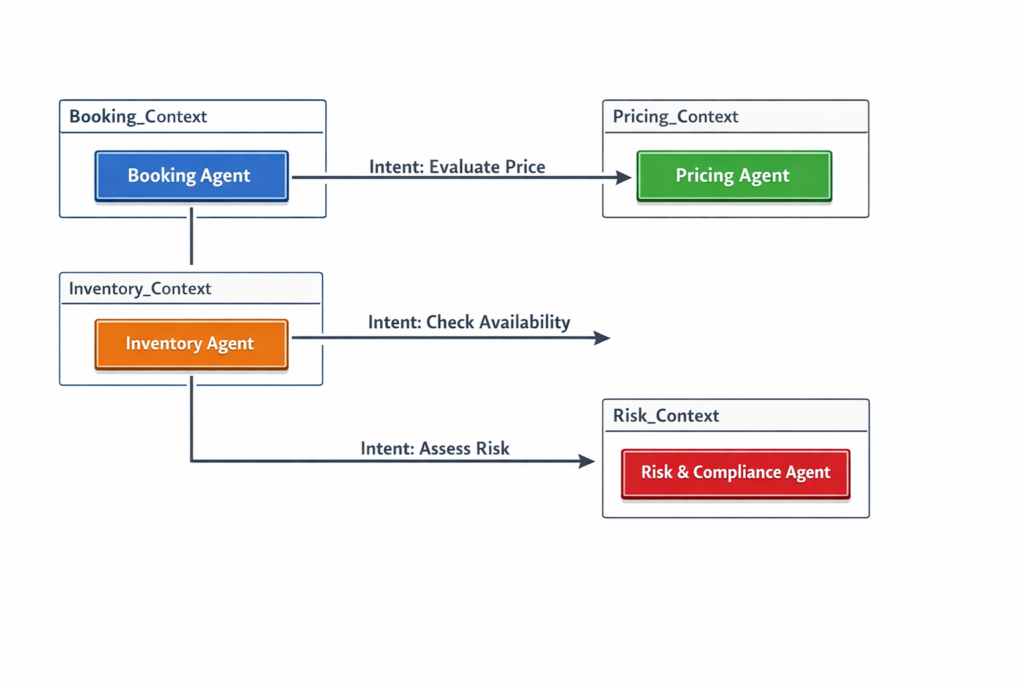 Each agent owns its context completely. No agent directly manipulates another agent’s internal state or logic.
Model Context Protocol as a Governance Layer
The Need for Context Control
As agents become more autonomous, unrestricted access to data and tools introduces significant risk: domain leakage, policy violations, and non-deterministic behavior.
The Model Context Protocol (MCP) addresses this by acting as a runtime guardrail. Whether leveraging open standards or internal protocols, MCP defines:
- Context: What information an agent may consume.
- Tools: Which actions are permitted.
- Output: How decisions must be structured.
Safety and “Human-in-the-Loop”
Crucially, MCP provides a layer for safety and compliance. If an agent begins to hallucinate or drift from its mandate, the MCP layer can cut off tool access immediately—effectively acting as a “kill switch” that doesn’t require redeploying code.
Diagram: MCP-Governed Agent Execution
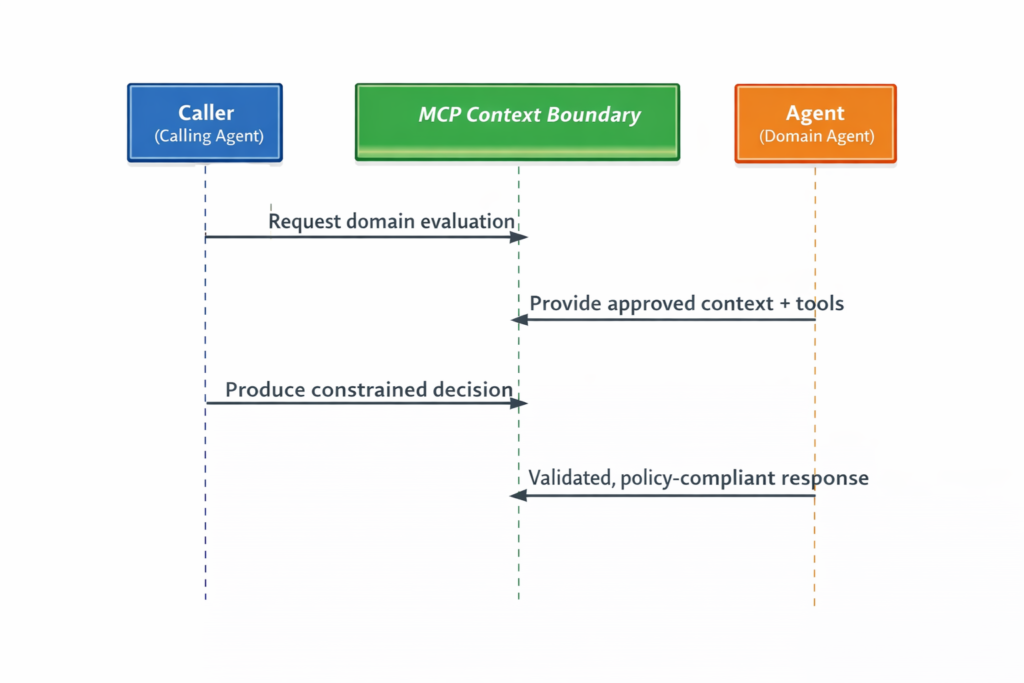 This structure ensures that intelligence operates within explicit architectural constraints.
Aligning DDD Concepts with A2A and MCP
The combined model maps naturally onto established DDD principles:
| DDD Concept | Runtime Interpretation |
| Bounded Context | Agent boundary |
| Aggregate | Agent-owned state |
| Domain Service | Agent capability |
| Domain Event | Agent message |
| Anti-Corruption Layer | MCP-enforced interface |
| Ubiquitous Language | Context schemas and contracts |
This alignment preserves DDD’s rigor while extending it into execution and collaboration.
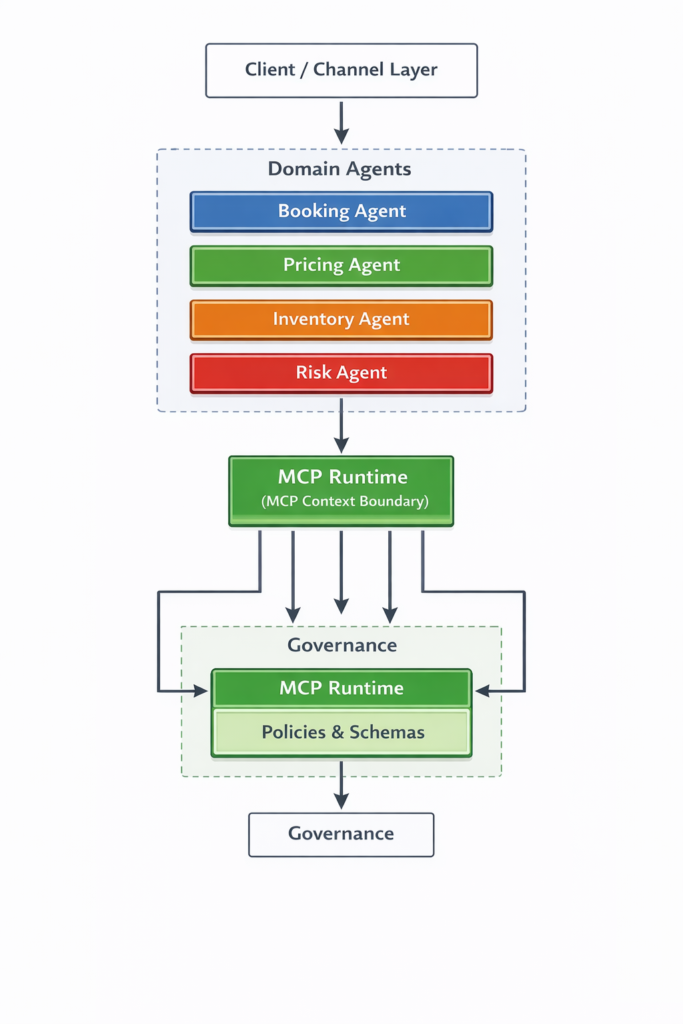
Reference Architecture: Domain-Centric Intelligent Platform
High-Level Architecture
 Key Architectural Properties
- No direct agent-to-agent coupling without governance: All decisions pass through context validation.
- Explicit Domain Ownership: Responsibilities remain clear and enforceable.
- The Latency vs. Safety Trade-off: While routing decisions through a governance layer introduces minimal latency, this overhead is often negligible compared to the inference time of LLMs. In regulated enterprise environments, this is a necessary price for decision safety and auditability.
Observability and Auditability by Design
Traditional observability focuses on latency, throughput, and error rates. Domain-centric intelligent systems require decision observability.
With A2A and MCP, systems can record:
- Which agent made a decision.
- What contextual inputs were used.
- Which policies or rules applied.
- Why alternative outcomes were rejected.
This moves logging from “System Error at line 42” to “Risk Agent rejected transaction due to Policy 105.”
Organizational and Delivery Implications
This architecture naturally aligns with organizational design (Conway’s Law):
- Teams own agents mapped to their domain expertise.
- Cross-team coordination occurs via explicit contracts (schemas).
- Changes are localized to domain boundaries.
- Intelligence evolves incrementally: You can upgrade the “Pricing Agent” model without breaking the “Booking Agent.”
From Endpoint-Driven APIs to Capability-Driven Systems
A final but critical shift is conceptual:
- APIs expose operations.
- Agents expose capabilities.
Capability-driven systems reflect business intent more accurately and remain stable even as internal implementations change.
Conclusion
The integration of Agent-to-Agent communication, Model Context Protocol, and Domain-Driven Design represents a natural evolution of distributed system architecture.
- DDD provides semantic clarity.
- A2A enables autonomous domain collaboration.
- MCP enforces governance and trust at runtime.
Together, they form an architecture that is intelligible, governable, and prepared for intelligent, decision-centric workloads. This approach is not a departure from established principles—it is their logical continuation.